Multiple society journals are collaborating to bring you more biogeography news
Above: A montage of the societies whose journals are now bringing you Biogeography.News
We are delighted to announce that we are breaking new ground in our mission at Biogeography.News https://biogeographynews.org/2023/12/10/re-introducing-biogeography-news/
Over the past year-and-a-half we have been working on several projects to build community across journals and societies. At Biogeography.News we are now delighted to report that we are collaborating with The American Naturalist, Biogeographia, Applied Vegetation Science, Journal of Evolutionary Biology, and the Journal of Vegetation Science to highlight research across the journals and to bring more biogeography news more easily to our shared communities. Our focus remains to highlight early career and global research, to help promote a more equitable and sustainable global research and scientific community.
As the number of venues for publishing biogeographical research has increased in recent years and support for the community from the Wiley journals historically serving the discipline’s core has become unreliable (Peterson et al. 2019; Williams et al. 2023), the biogeographical literature has become more fragmented. With those dynamics — driven by competition among for-profit publishers for copy — we rely more on search tools for making sense of the literature and there has been a certain loss of coherence and natural organization. Societies are addressing this by doing important work in supporting their communities and publishing in their discipline, while many of us are members of multiple societies and publish in multiple journals. As such, there is an important opportunity to build a meta-community for biogeography that reaches across journals and societies. This is our goal here at Biogeography.News — to provide easily digestible summaries of new research across a diversity of disciplines — and we expect the number and range of journals and societies that are involved to keep growing.
If you are an author, journal editor, or society board member and would like to support this Biogeography.News initiative, please see the contact information below. Drop us a line and learn how!
This initiative is consistent with the goals of a related project — Publishing for an Ethical and Equitable Environment in Research (PEEER) — whose goal is “to foster a culture in which authors, editors, and reviewers … support … a healthy scientific and research community.” For more information see https://peeer.net.
About the collaborating journals and societies
– The American Naturalist, since its inception in 1867, has maintained its position as one of the world’s premier peer-reviewed publications in ecology, evolution, and behavior research. Its goals are to publish articles that are of broad interest to the readership, pose new and significant problems, introduce novel subjects, develop conceptual unification, and change the way people think. The American Naturalist emphasizes sophisticated methodologies and innovative theoretical syntheses — all in an effort to advance the knowledge of organic evolution and other broad biological principles. The journal is published by the American Society of Naturalists (ASN) which is the oldest scientific society dedicated to the study of ecology, evolution, and behavior. The goal of the society is to advance and to diffuse knowledge of organic evolution and other broad biological principles so as to enhance the conceptual unification of the biological sciences.
– Biogeographia – The Journal of Integrative Biogeography is a scientific journal publishing original research and reviews in biogeography since 1970. The journal considers papers dealing with clear hypotheses, large data sets, convincing analyses or interesting results on the distribution of organisms, as well as purely descriptive studies embedded in a theoretical framework or providing unique primary data of high potential future scientific value. The journal is published on behalf of the Italian Biogeography Society (Società Italiana di Biogeografia, SIB [in Italian only]). The society was officially founded in 1962 from the previous informal Gruppo Italiano Biogeografi, and from 1970 has published its own journal (originally, Biogeographia – Lavori della Società Italiana di Biogeografia).
– The Journal of Evolutionary Biology (JEB), founded in 1988 is a peer-reviewed, international journal owned by the European Society of Evolutionary Biology (ESEB). The journal seeks to publish articles that advance the understanding of the evolutionary process and are of interest to a broad evolutionary readership. The journal prioritises robust and well-executed studies that ask novel questions and/or provide new insights, generalisable across taxonomic groups. JEB considers submissions describing research from across the field of evolutionary biology, including evolutionary genetics and genomics, molecular evolution and phylogenetics, life histories, evolutionary ecology, development, or morphology. The journal covers both micro- and macro-evolution, as well as empirical, computational, and theoretical work.
ESEB itself, founded in 1987, aims to promote the study of evolution on an international scale. The society brings together thousands of evolutionary biologists from Europe and the rest of the world – researchers, lecturers, students, as well as journalists and other interested parties.
– The Journal of Vegetation Science (JVS), established in 1990, focuses on all aspects of plant community ecology and the macroecology of vegetation. Articles may cover any aspect of vegetation science, including community structure, biodiversity, spatial patterns, temporal changes, and processes, and emphasizing research that develops new concepts or methods, tests theories and reveals general patterns in plant communities.
– Applied Vegetation Science (AVS), established in 1998, focuses on plant community ecology topics relevant to human interaction with vegetation. Global environmental change, nature conservation and management, restoration of plant communities and natural habitats, and planning of semi-natural and urban landscapes are of particular interest.JVS and AVS are owned by the International Association for Vegetation Science (IAVS). IAVS is a worldwide union of scientists and others interested in theoretical and practical studies of vegetation: its composition and structure, history, classification, distribution, ecology, dynamics, management and uses in the landscape. The society was officially founded in 1954 from the previous informal International Phytosociological Society.
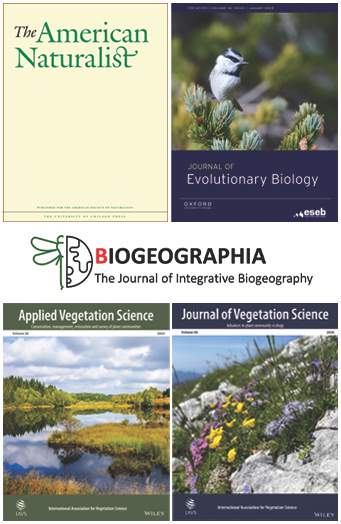
Above: A montage of the journals contributing to Biogeography.News
How to contribute:
Via the societies’ journals
When you receive an acceptance letter from participating journals, it will include information on how to contribute. Look for text similar to the following:
For journals that focus on biogeography (e.g. Biogeographia): “If you are interested in contributing a blog post about your accepted paper to Biogeography.News, please reach out to biogeographynews@gmail.com with the subject “BN contribution – ” and your name.”
For journals that include, but do not focus primarily on, biogeographical studies (e.g. The American Naturalist, Journal of Evolutionary Biology, and the IAVS journals): “If your article focuses on a biogeographical topic, you can contribute a blog post about it to Biogeography.News. If you are interested, please reach out to biogeographynews@gmail.com with the subject “BN contribution – ” and your name.”
Direct to Biogeography.News
Write to biogeographynews@gmail.com and for full instructions see our original post on “How to Contribute to Biogeography.News.” Briefly, there are several ways that you can devise a feature for Biogeography.News:
– Question + Answer
– Short essay
– Short video
– Graphical abstract
– Significance statement.
We aim to accompany each feature with several photos that will be posted on Biogeography.News’ social media platforms. Ideally, these would be high resolution images and would include: (1) a clear picture of yourself, and (2) several shots of your study organism and/or system, both accompanied with captions. We assume that images belong to you, or that you have permission to use them. Where images do not belong to you, it is important you credit the owner and let us know you have permission.
Why Biogeography.News? See https://biogeographynews.org/2023/12/10/re-introducing-biogeography-news/
To join the editorial team at Biogeography.News write with a few lines about (1) your areas of expertise/interest, (2) the journal and/or geographic region you’d like to cover, and (3) your publishing history, to: biogeographynews@gmail.com
The same contact information will work if you have any general questions or if you wish to make comments.
We look forward to hearing from, and working with, you!
Contributors:
Mike Dawson, UC Merced, USA – Biogeography.News
Milan Chytrý, Masaryk University, Czech Republic – Journal of Vegetation Science & Applied Vegetation Science
Diego Fontaneto, CNR-IRSA Verbania, Italy – Biogeographia
André Liz, BIOPOLIS/CIBIO-InBIO: Porto, Portugal – Biogeography.News
Max Reuter, University College London, UK – Journal of Evolutionary Biology
Volger Rudolf, Rice University, USA – The American Naturalist
 Biogeography.News