Josh is a Postdoc researcher at King’s College London. He is a community ecologist with special focus on plant invasions. Here, Josh shares his recent work which reviews the use of scale terms in plant biology and consequent implications for biogeographic research.
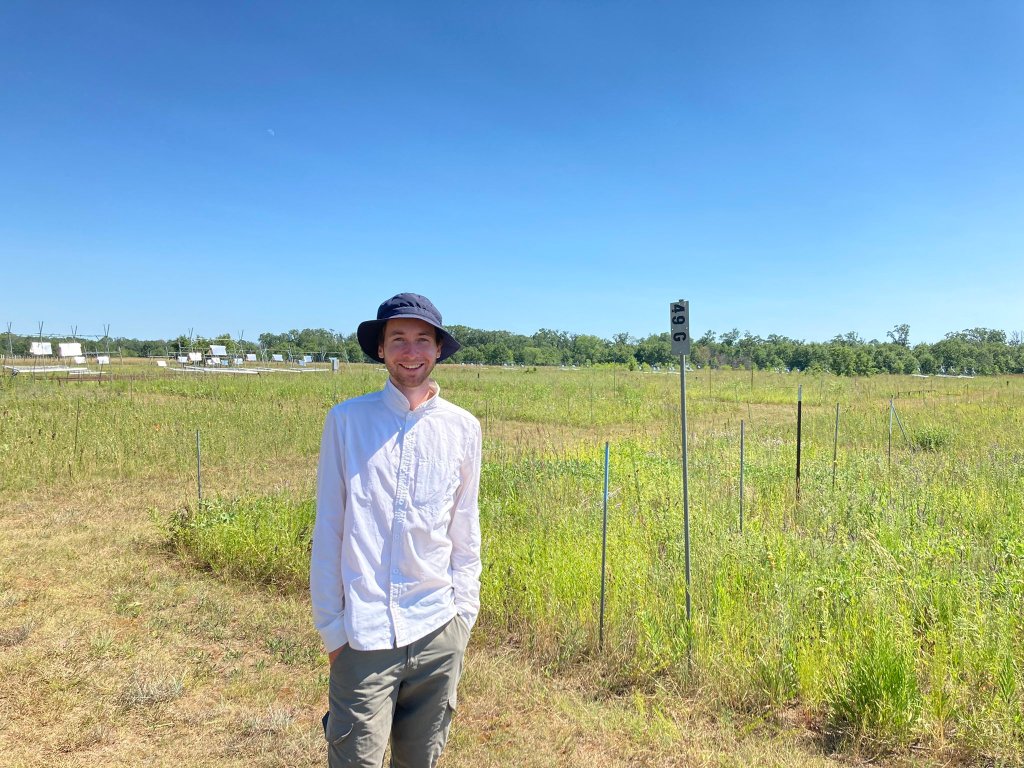
Josh standing in ‘BigBio’, one of the longest-running experiments testing the role of plant diversity on ecosystem function.
Personal links. Personal website | Google Scholar | X | Bluesky
Institute. King’s College London
Academic life stage. Postdoc
Major research themes. Community assembly, diversity and persistence, with a particular emphasis on plant invasions and cross-trophic interactions (e.g. parasitism, mutualism, herbivory), and how evidence for all the above varies with the scale at which communities are studied!
Recent paper (citation). Hung, C. Y., Pérez‐Navarro, M. Á., & Brian, J. I. (2025). Lost in Space: When Spatial Scale Terms Blur Actual Study Size in Plant Community Ecology. Journal of Vegetation Science, 36(3), e70035. https://doi.org/10.1111/jvs.70035
Current study system. We study plant communities, particularly terrestrial grasslands, though this paper covered all major terrestrial plant habitats (e.g. forests, shrublands, etc). Grasslands are globally distributed and highly diverse, which means they provide a great opportunity for understanding how factors like environmental variation drive community diversity and interactions. Grasslands are also highly invaded ecosystems, so by studying which grasslands are more or less invaded, we might be able to understand more about the biogeography of invasion. However, this relies on being able to make fair comparisons between studies carried out in different locations, which stimulated the motivation for this paper.
Motivation behind this paper. It is well recognised that many biogeographic patterns are scale-dependent: For example, at ‘small’ scales, invasive plant diversity and native plant diversity are negatively correlated (possibly reflecting signals of plant-plant competition), but at ‘large’ scales they are positively correlated (likely reflecting increased habitat heterogeneity at larger scales). Many different words, which we call ‘scale terms’, are used to denote these different scales. Scale terms like “local” or “neighbourhood” are used to indicate the scales at which plants might compete, while terms like “region” are used to indicate scales where the role of habitat type might be detected. However, we were unsure whether these terms are used consistently: are different papers that use the term “local” actually referring to similar study scales? Or does one paper use it to refer to 1m2 plots (for example), while another uses it to refer to 20m2 plots? If these scale terms are used inconsistently, it could have major negative implications for drawing biogeographic conclusions by synthesising results from different studies.
Key methodologies. To our knowledge, we carried out the first review of this question in plant biology. We searched studies that use one or more scale terms to frame their results and conclusions, then examined the methods to see what actual area they were referring to when they used these scale terms. We also tested whether the area referred to by scale terms varies with habitat type (e.g. grassland vs. forest), geographic location (e.g. Europe vs. Asia) and type of study (e.g. experimental vs. observational). This provides the first insights into how these scale terms, which are often used and accepted uncritically by authors, are employed across the globe.
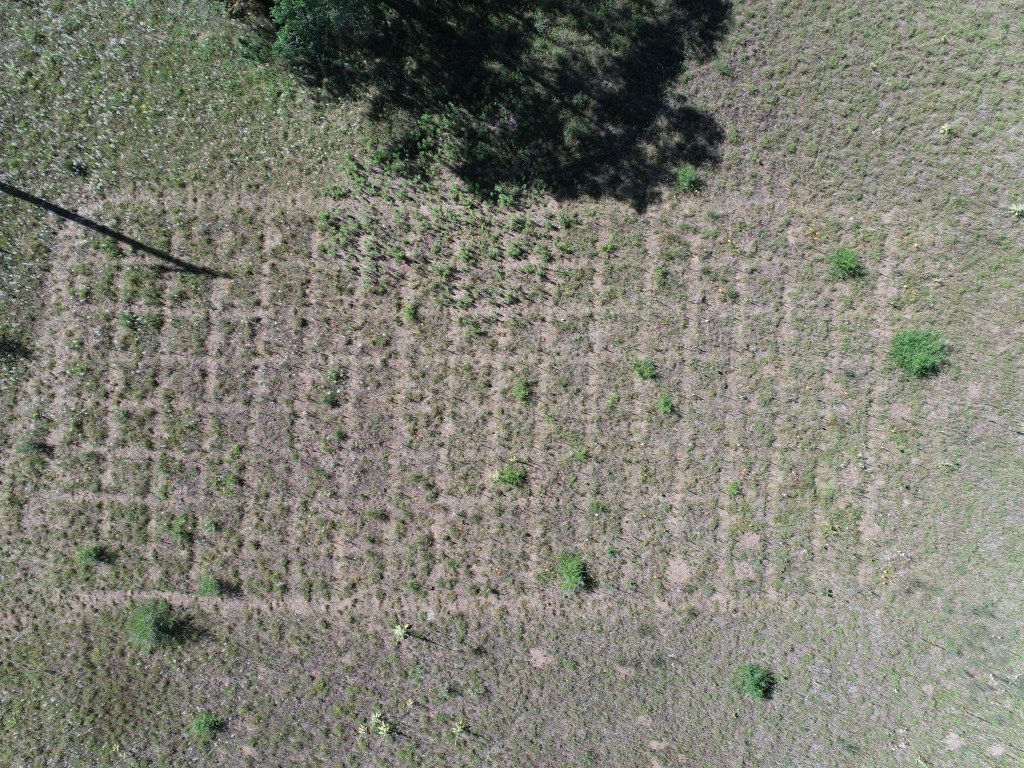
Experimental plots like these are common in plant ecology. But how transferable are findings from this experiment to plots that are bigger or smaller? (Drone photo Maggie Anderson; experimental set-up Josh Brian)
Unexpected challenges. One unexpected challenge was how difficult the literature review was! We had expected that the area (e.g. the size of a plot used) should be easy to find, as this is basic methodological information. However, this information was often hard to interpret, buried in the supplementary materials, or not there at all! Over 21% of studies didn’t report the actual area for at least one of the scale terms they used – so 21% of studies are not reproducible from this minor methodological point alone!
Major results. We found massive variation in the use of individual scale terms – on average, 4.7 orders of magnitude. While this variation could partially be explained by the type of study (e.g. observational scales tend to be larger than experimental scales for any given scale term) and habitat type (e.g. forest scale terms tend to be larger than in grasslands), there was still variation of 3.8 orders of magnitude within single habitats. For example, “local” scales in grasslands alone can refer to areas from 1m2 to 100,000m2! We did a little simulation, and found that this inconsistency could have major implications for calculating and comparing biodiversity metrics (e.g. Shannon’s Index) across studies. If biogeographic research is going to be reproducible and synthesisable, attention needs to be paid to how we use such terms.
Next steps for this research. The next step is really up to the community! We provide some guidelines in the paper on how we can improve matters. Authors of individual papers should make sure that the actual study area is clearly stated in the methods (at a minimum!), and authors of syntheses should make sure studies are being combined or compared based on their actual areas of investigation, rather than relying on scale terms to combine papers.
If you could study any organism on Earth, what would it be? I would love to study parasites of organisms in Antarctica – parasites in general are understudied, and I’m sure the extreme conditions there must have led to some amazing adaptations for transmission and survival. Plus, who wouldn’t want to go to Antarctica?
Is there anything else you would like to tell us about yourself or your featured research? This work was led by an undergrad, Chung Yi Hung, and funded by a King’s College London Undergraduate Research Fellowship. It’s absolutely amazing to see an undergrad do most of the work for a scientific paper – my co-senior author María and I got incredibly lucky to work with someone so talented!
 Biogeography.News