Wesley is a Postdoctoral researcher at the AMAP (botAnique et Modélisation de l’Architecture des Plantes et des Végétations) research group in Montpellier, France. He is a functional ecologist with special focus on tropical forests and savannahs. Here, Wesley shares his recent work on the distribution of plant functional traits across ecotones.
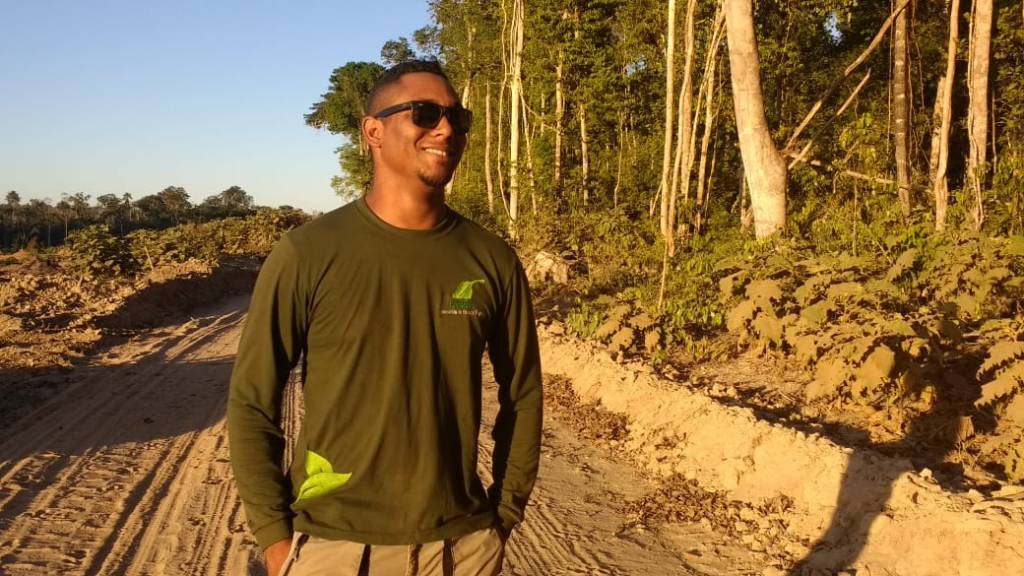
Early career researcher, Wesley, after a field day on the southern edge of the Amazon, Brazil.
Personal links. Google Scholar
Institute. AMAP (botAnique et Modélisation de l’Architecture des Plantes et des Végétations), CIRAD, CNRS, INRAE, IRD, Montpellier, France.
Academic life stage. Postdoc
Major research themes. Functional ecology, tropical forests and savannahs, ecotones, biogeography, ecophysiology, disturbances, vegetation monitoring.
Recent paper (citation). Cruz, W. J. A., Marimon, B. S., Junior, B. H. M., Morandi, P. S., Longhi, S. G., Prestes, N. C. C. D. S., … & Phillips, O. L. (2025). Functional Biogeography and Ecological Strategies of Trees Across the Amazon–Cerrado Transition. Journal of Vegetation Science, 36(5), e70076. https://doi.org/10.1111/jvs.70076
Current study system. In central Brazil, the Cerrado, Amazon, and Pantanal converge, forming one of the most complex ecological mosaics on Earth. Acting as a continental regulator, this interconnected system links hydrological and climatic processes across tropical South America. The Amazon drives regional rainfall through atmospheric moisture transport; the Cerrado functions as a major water source feeding continental river basins; and the Pantanal acts as a vast hydrological buffer. This unique transition zone, hosting a mosaic of forests, savannas, and grasslands, remains poorly understood regarding its vulnerability to compound drought–fire–heat stresses.
Motivation behind this paper. Understanding how species traits and ecological processes respond to environmental variations and disturbances in this region. This ecotone is home to striking gradients in climate, soil, and vegetation structure, which directly influence the functional strategies of plants and the resilience of ecosystems. By integrating species distribution patterns and ecological functions, it is possible to identify mechanisms that determine the maintenance of biodiversity and predict responses to climate change and land use. In addition, little-explored types of vegetation, such as woodland savannahs, seasonal forests, floodplain forests and riparian forests, represent key components of this transition, but still lack detailed studies on their ecological functions and biogeographical roles.
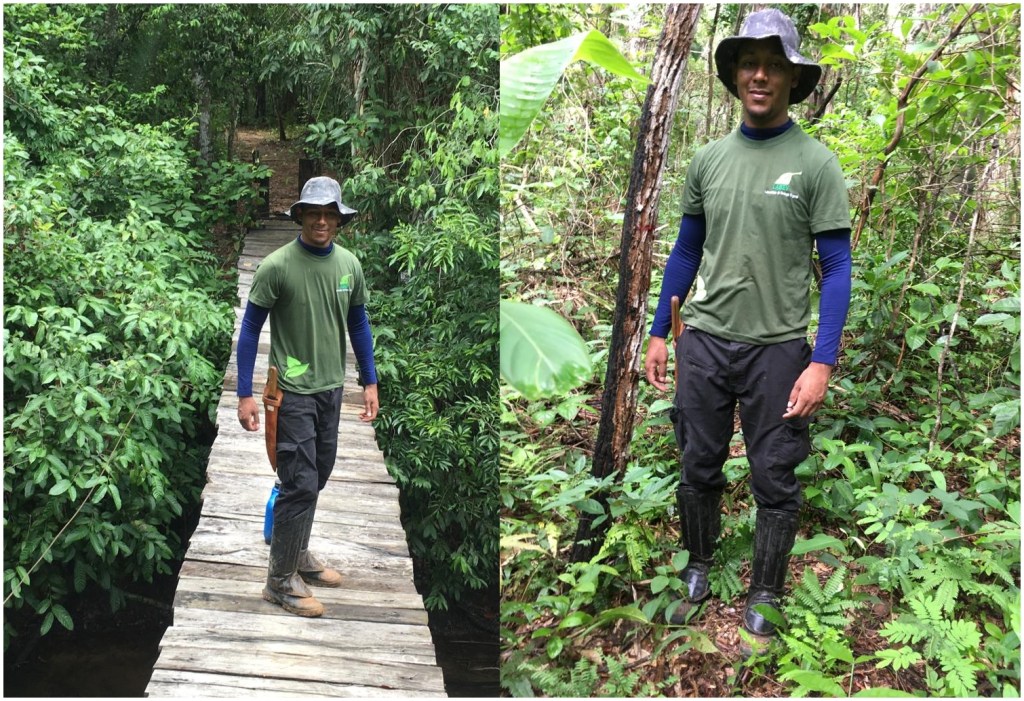
Wesley crossing bridges and investigating transitional forests in the ecotone between the Amazon and the Cerrado, at the Serra das Araras Ecological Station, Mato Grosso, Brazil.
Key methodologies. The paper presents a relevant methodological innovation by applying a standardised protocol for collecting functional traits of trees in a transition zone between biomes. We gathered data for approximately 200 tree species distributed across six different vegetation types, generating 55,895 measurements of functional traits. We selected 15 traits, covering key aspects of ecological processes and species strategies, and applied the same measurement protocol in environments ranging from typical savannahs to moist forests. Thus, the study enables a robust and homogeneous comparison between different vegetation formations, something rare until now on this ecological and biogeographical scale. The single, standardised protocol ensures that the differences observed reflect real variations in functional traits rather than methodological biases, strengthening inferences about how environmental filters and species strategies change along this Amazon–Cerrado gradient.
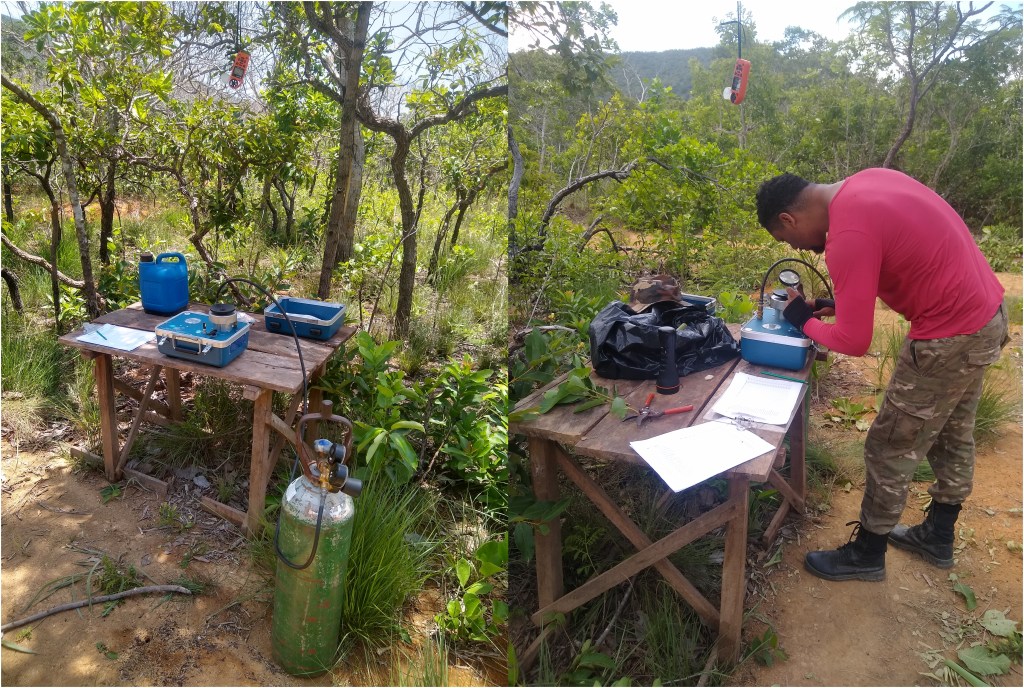
Mega structure of Wesley’s Functional Ecology and Ecophysiology Laboratory. Set up outdoors, within a savannah, in central Brazil. At the time, measuring functional leaf traits and the water potential of leaves at midday.
Unexpected challenges. To me, the greatest challenge of this research was the intense fieldwork and complex processing of samples collected across a wide spatial scale. The study areas were spread over approximately 1,000 km between different types of vegetation in the Amazon–Cerrado transition zone, requiring careful logistics, long expeditions, and rigorous standardisation of collections. Obtaining functional data for approximately 200 species required precision and consistency at all stages, from collection to laboratory analysis. This effort was only possible thanks to the dedication of a highly trained team and the technical support of a laboratory of excellence – Plant Ecology Laboratory of the Universidade do Estado de Mato Grosso (UNEMAT), Nova Xavantina, Mato Grosso, Brazil.
Major results. The main result of this paper was to demonstrate how the functional strategies of tree species vary systematically along the gradient between the Amazon and the Cerrado, reflecting the combined influence of climatic and edaphic factors. This novel approach integrates functional biogeography into one of the most ecologically complex regions on the planet, providing a solid empirical basis for understanding how biodiversity and ecosystem functioning respond to broad environmental gradients. The study also advances our understanding of the functional structure of underexplored vegetation types such as the Cerradão (woodland savannah), gallery forests, and semi-deciduous and evergreen seasonal forests. The study represents a significant contribution to functional ecology and to the development of predictive models of tropical vegetation response to climate change and land use.
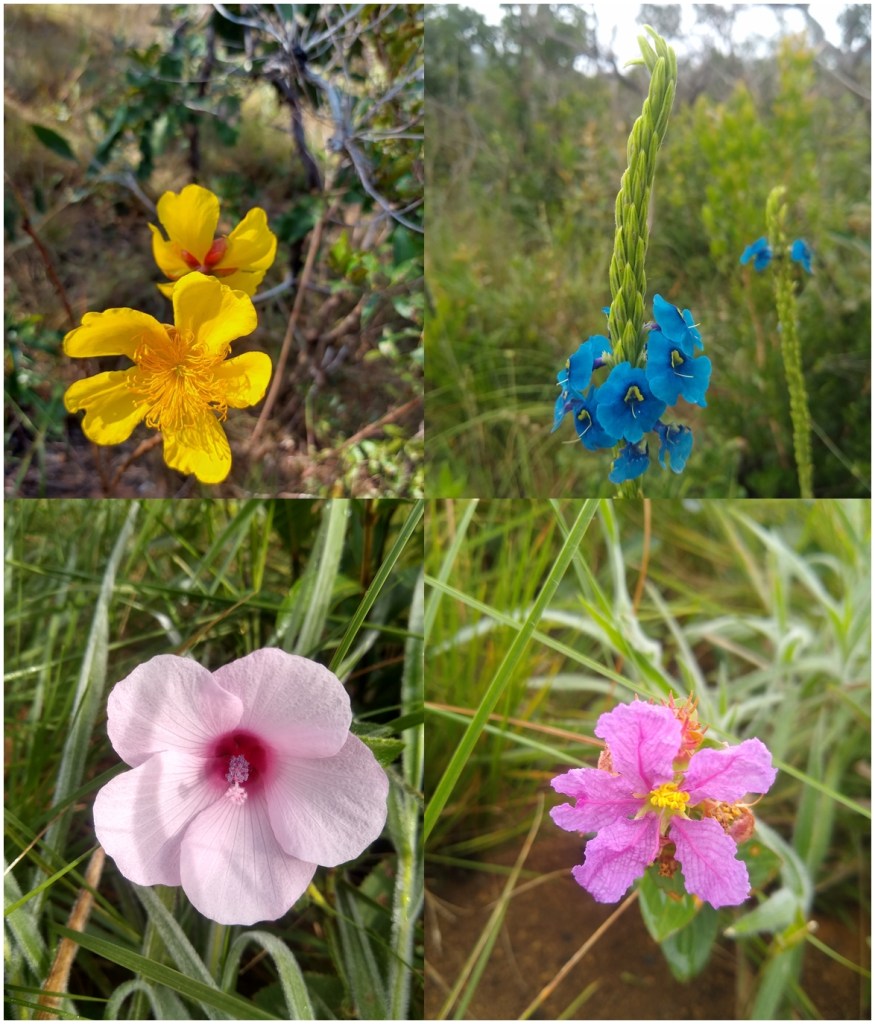
Flowers and colours of the herbaceous component of a transitional savannah in Brazil, at the Serra das Araras Ecological Station.
Next steps for this research. The next logical step in this research is to investigate the intraspecific variability of the functional traits of species occurring along the Amazon–Cerrado transition. Although the current study revealed robust patterns between species and vegetation formations, understanding the variation within species themselves is essential to assess their adaptive potential in the face of environmental gradients and disturbances. This approach will allow us to identify locally adapted populations and draw boundaries of functional plasticity, providing crucial information for predicting ecological responses to climate change and guiding conservation and restoration strategies.

Wesley walking on the ashes of a transitional forest burned in the catastrophic fires of August 2024. Assessing the impact of fire on forests in the transition zone between the Amazon and the Cerrado (photo: Francisco Navarro-Rosales).
If you could study any organism on Earth, what would it be? I consider the duality of trees that live in seasonally flooded savannahs to be fascinating. Trees established in floodplain savannahs play a key ecological role in maintaining the structure and functioning of these ecosystems. They must cope with extreme environmental conditions, alternating between long periods of flooding and phases of intense drought, which requires remarkable physiological plasticity.
 Biogeography.News