Rohit is a PhD student at the National Centre for Biological Science, India, and New Mexico State University, U.S.A. He is an ecologist with special focus on the impact of top-down factors on savanna ecosystems. Here, Rohit shares his recent work on tree-tree interactions in a mesic savanna of southern India.

Rohit Subhedar, PhD student at New Mexico State University. Photo by Geraldine Diverres
Personal links. LinkedIn | Instagram | ResearchGate
Institute. National Centre for Biological Sciences – India; New Mexico State University, United States of America
Academic life stage. PhD Student
Major research themes. Rohit is broadly interested in understanding how climate, fire and mammalian herbivory interactively govern savanna ecosystems.
Recent paper. Subhedar, R., Ratnam, J., & Sankaran, M. (2025). Spatial Patterns of Woody Plants and Tree‐Tree Interactions in an Indian Mesic Savanna. Journal of Vegetation Science, 36(6), e70089. https://doi.org/10.1111/jvs.70089
Current study system. Savannas are tree-grass ecosystems that cover 20% of the Earth’s surface, support a fifth of the global human population and are home to some of the most iconic wildlife on the planet. Given their immense socio-economic and ecological importance, understanding what maintains this delicate balance of trees and grasses in savannas is a central focus for ecologists.
Motivation behind this paper. Much research in savanna ecology has thus far focused on understanding tree-grass interactions (such as competition or facilitation). However, relatively little information exists on tree-tree interactions, which can be equally important in structuring savannas. Further, these interactions can change across life stages of woody plants, but few studies have incorporated these aspects. We addressed these research gaps by using data from a long-term vegetation monitoring plot in an Indian mesic savanna.
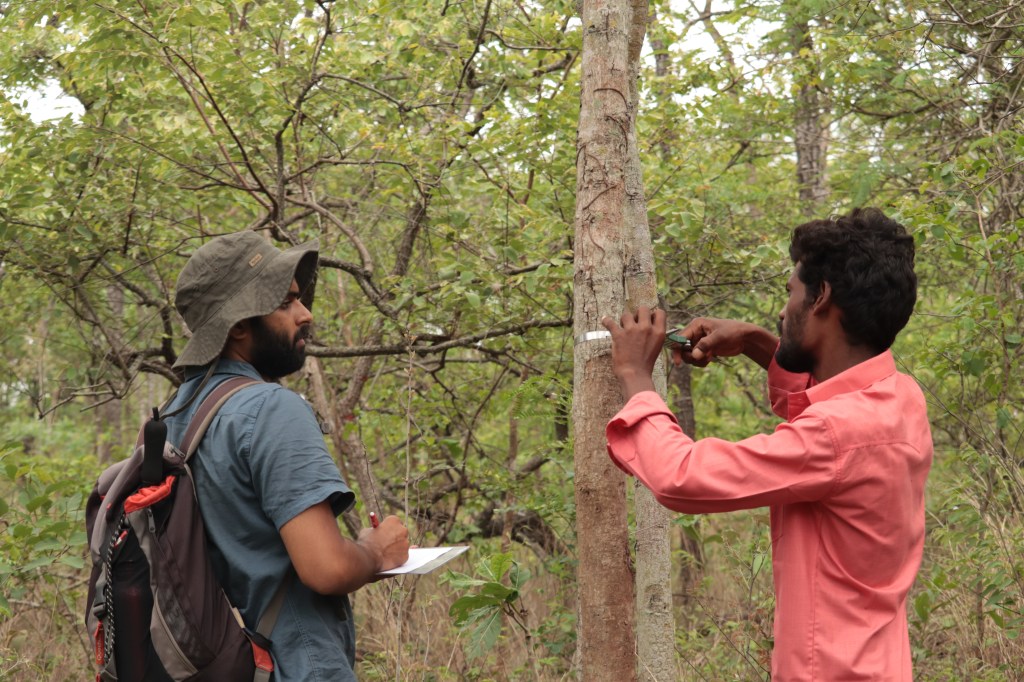
Rohit and field associate Peddanna during fieldwork in the mesic savannas of southern India. Photo by Aaroha Malagi.
Key methodologies. We evaluated spatial patterns of trees using point pattern analysis and inferred the nature of tree-tree interactions by examining neighbourhood effects, both conspecific and heterospecific, on plant survival and growth across two life stages, saplings and adult trees.
Major results. We found that saplings were strongly aggregated while adult trees were randomly distributed. The spatial aggregation at the sapling stage was linked to dispersal mode, with wind-dispersed species showing strong aggregation relative to animal-dispersed species. However, despite strong spatial clustering, sapling growth and survival over 4 years were unaffected by neighbours (adults and saplings). Instead, initial size (basal area at first census) was the single best predictor of both sapling growth and survival. In contrast, adult neighbours negatively affected adult tree growth. These results suggest that tree-tree interactions vary from neutral at the sapling stage to negative at the adult stage, highlighting the potential role of competitive interactions in structuring Indian mesic savannas.
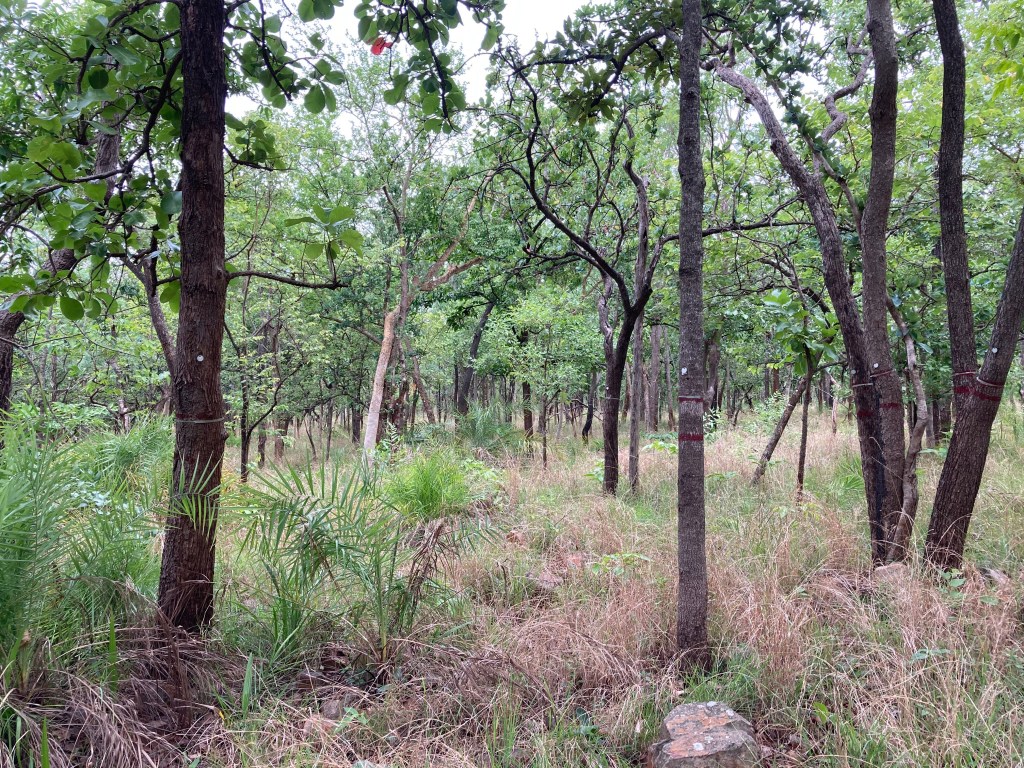
Mesic savanna in the study region characterised by a densely wooded overstory and a C4 grassy understory. Photo by Rohit Subhedar.
Next steps for this research. Future work will focus on understanding what limits woody sapling performance and how episodic events, such as droughts and fires, influence the nature of tree-tree interactions in Indian savannas.
If you could study any organism on Earth, what would it be? It is difficult to pick one, but I find all large herbivores fascinating. I am broadly interested in how they shape ecosystems via effects on plant communities. Some of my work for my PhD focuses on these aspects.
 Biogeography.News