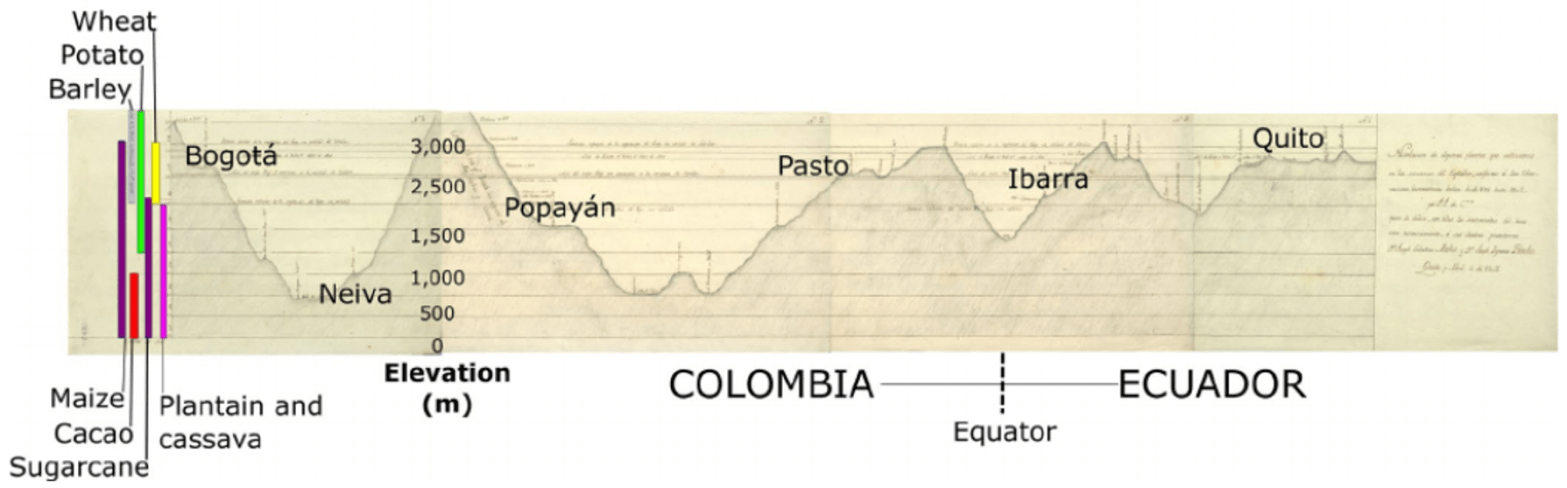
A paper describing two centuries of changes in crop regions is awarded the Humboldt-Caldas medal 2021 for best biogeography paper in Colombia/Ecuador. Above: Original cartography of Caldas’ crop regions showing the colonial profile of the travel route with vertical elevations, towns and the different crops Ali Salim. Ever since I began studying plant biology, IContinue reading “Award highlight: Connecting the past with the present”
Author Archives: BiogeographyNews
Time waits for no one, except in cities
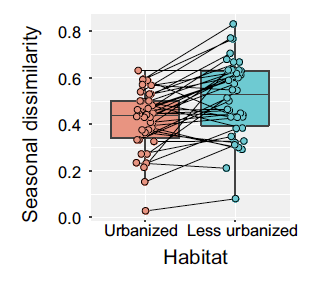
‘Change is the only constant in life’ and in the Anthropocene the nature of change is being altered too. Though we often associate human activities with increasing rates, a new study of urbanization shows that in some places we are in effect slowing down time instead. Above: Seasonal dissimilarity of bird community composition in urbanizedContinue reading “Time waits for no one, except in cities”
Pool diversity shapes unique island communities

Compiling a new island dataset enables a global perspective on the unique diversity of the smallest communities. Above: A group of small islands Pianemo, Raja Ampat, Indonesia. Like many before us, we studied island systems to better understand the drivers community composition. Photo by Sutirta Budiman on Unsplash. Island biogeography is one of the mostContinue reading “Pool diversity shapes unique island communities”
ECR Feature: Isabel Haro-Bilbao & Josh Thia on the use of genomics to identify fisheries stocks
Isabel Haro-Bilbao and Josh Thia met while completing their PhD’s at the University of Queensland, Australia. Both had interests in the ecology of marine organisms, which led them to collaborate on a project investigating genetic differentiation in the wahoo, a large, highly dispersive pelagic fish. Isabel and Josh share how they used population genomic approachesContinue reading “ECR Feature: Isabel Haro-Bilbao & Josh Thia on the use of genomics to identify fisheries stocks”
Are there general principles governing geographical range evolution?

A simple rule that unites geographical range evolution across terrestrial and marine environments. Above: Holacanthus ciliaris (left) is broadly distributed, from the state of Florida (USA) to Santa Catarina (southern Brazil), whereas Hyplopectrus providencialis is endemic to the Caribbean islands of San Andrés and Providencia. Photographs by Osmar J. Luiz.. If one were to askContinue reading “Are there general principles governing geographical range evolution?”
ECR Feature: Ruan van Mazijk on floral species-area relationships and environmental heterogeneity
Ruan van Mazijk is a Masters student at the University of Cape Town. He is broadly interested in the ecology and evolution of plants. Ruan shares his recent work on how environmental heterogeneity influences species-area relationships in floral species from the Greater Cape Floristic Region and the Southwest Australia Floristic Region. Ruan watching the sunsetContinue reading “ECR Feature: Ruan van Mazijk on floral species-area relationships and environmental heterogeneity”
ECr Feature: Leo Ohyama on species-area diversity relationships in ants
Leo Ohyama is currently working toward his PhD at the University of Florida. He is an ecologist broadly interested in processes that shape the distribution of biodiversity. Leo shares his recent work on how species divesity scales across space in ant species across the globe. Leo digging for ants in the flatwoods of Florida, USAContinue reading “ECr Feature: Leo Ohyama on species-area diversity relationships in ants”
ECR feature: Lucas Neves Perillo on megadiversity on ancient tropical mountains
Lucas Neves Perillo is a postdoc at the Universidade Federal de Minas Gerais in Brazil. He is a biologist interested in conservation and science communication. Here, Lucas shares his recent work on disentangling the effects of latitudinal and elevational gradients on bee, wasp, and ant diversity in an ancient neotropical mountain range. Lucas Neves PerilloContinue reading “ECR feature: Lucas Neves Perillo on megadiversity on ancient tropical mountains”
ECR feature: Ryan Briscoe Runquist on predicting invasion risk
Ryan Briscoe Runquist is a postdoc at the University of Minnesota in the USA. She is an evolutionary ecologist interested in invasive species and their potential impacts in a changing world. Here, Ryan shares her recent work on predicting invasive species range expansion using Joint Species Distribution Model. R. Briscoe Runquist in front of aContinue reading “ECR feature: Ryan Briscoe Runquist on predicting invasion risk”
ECR feature: Brooks Kohli on the role of abiotic filters and competition assembling small mammals communities
Brooks Kohli is a postdoc at Ohio State University in the USA. He is an ecologist interested in understanding small mammal diversity and distribution. Here, Brooks shares his recent work on small mammal trait-base tests to reveal the importance of abiotic filters. Brooks Kohli, from the summit of Bald Mountain (in Great Basin National Park,Continue reading “ECR feature: Brooks Kohli on the role of abiotic filters and competition assembling small mammals communities”
 Biogeography.News