Enrico is a Postdoctoral researcher at the Institute of Evolutionary Biology (CSIC–Pompeu Fabra University). He is an entomologist with special focus on myrmecology. Here, Enrico shares his recent work on the distribution of the invasive red imported fire ant.
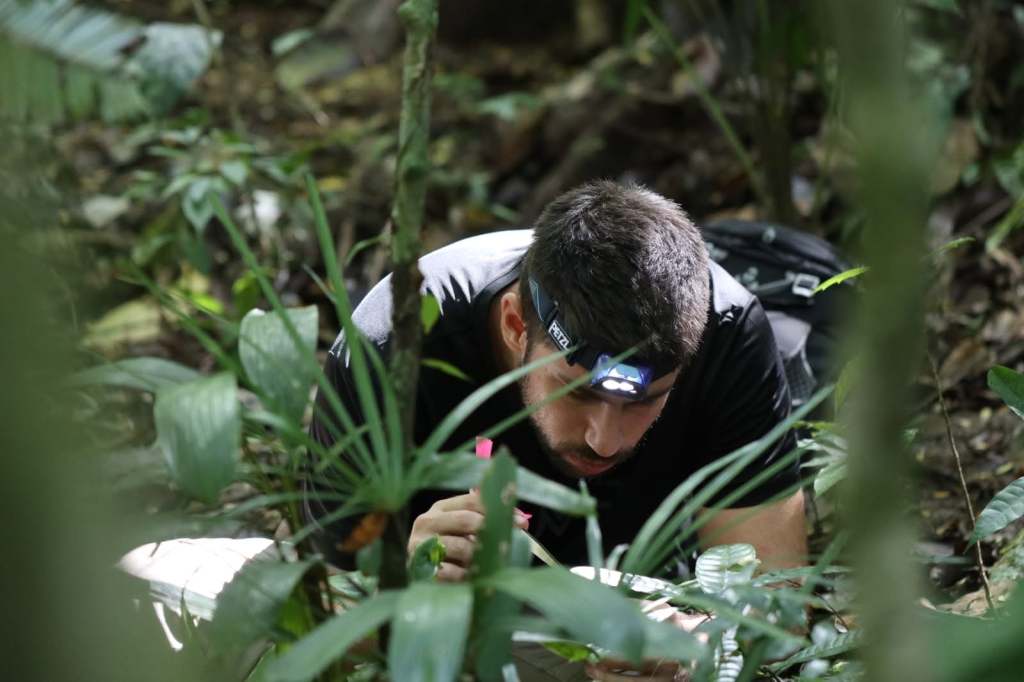
Ant collecting in Papua New Guinea as part of the 2023 AntCourse activities.
Personal links. ResearchGate
Institute. Institute of Evolutionary Biology (CSIC–Pompeu Fabra University), Barcelona, Spain
Academic life stage. Postdoc
Major research themes. I love studying ants (myrmecology) and approaching them from different perspectives, spanning from diversification, taxonomy, and biogeography, to their ecology, behaviour, and role in both natural and agricultural habitats. I have now published over 100 papers on this group of insects and I find myself in an exciting journey of constant discoveries – whether small or big. Ants are very diverse and extremely impactful across most terrestrial ecosystems, and their social behaviour makes them different from most other animals. So much is still undiscovered about their diversity patterns in the Mediterranean, the region I belong to as a Sicilian, which is among the global biodiversity hotspots for these insects, mainly due to its highly complex biogeographic history. While diversity here is much lower than in the tropics, the paleogeography and climate history of the region created a multitude of short-range species.
Recent paper. Schifani, E., Cilia, G., Deshayes, H., Mona, S., Scibilia, S., Vila, R., & Menchetti, M. (2026). The Italian invasion of Solenopsis invicta: wider distribution, penetration into natural habitats, and the surrounding ant fauna. Biogeographia, 41(2), a078. https://doi.org/10.21426/B6.68753
Current study system. I am working on many different parallel projects, mostly dealing with native and non-native ants in the Mediterranean and sometimes in other regions too. My main project now is building a comprehensive dated phylogeny of European ants using a backbone of genomic data and combining it with barcoding to cover as many species as possible. The results will tell us about how and when the diversity of species that we observe originated and offer a tool to quantify phylogenetic diversity in ecological studies. This is my first hands-on experience with genomic analyses, and I am enthusiastic about what I am learning in the process.
Motivation behind this paper. This paper deals with what is considered among the very worst non-native invasive species across much of the world, the red imported fire ant Solenopsis invicta. We were the first to discover the only known established population in Europe in 2023, in Sicily, Italy. The species is not only feared for its ecologically destructive potential and harmfulness to humans through the characteristic painful stings, but it is also included in EU legislation that mandates action from member states. In our paper we condense a lot of important information, providing an update on the spread of the invasion, on its history, and on the native ant fauna of the impacted areas, while giving a synthesis of what steps the European, Italian, and regional authorities have taken so far.
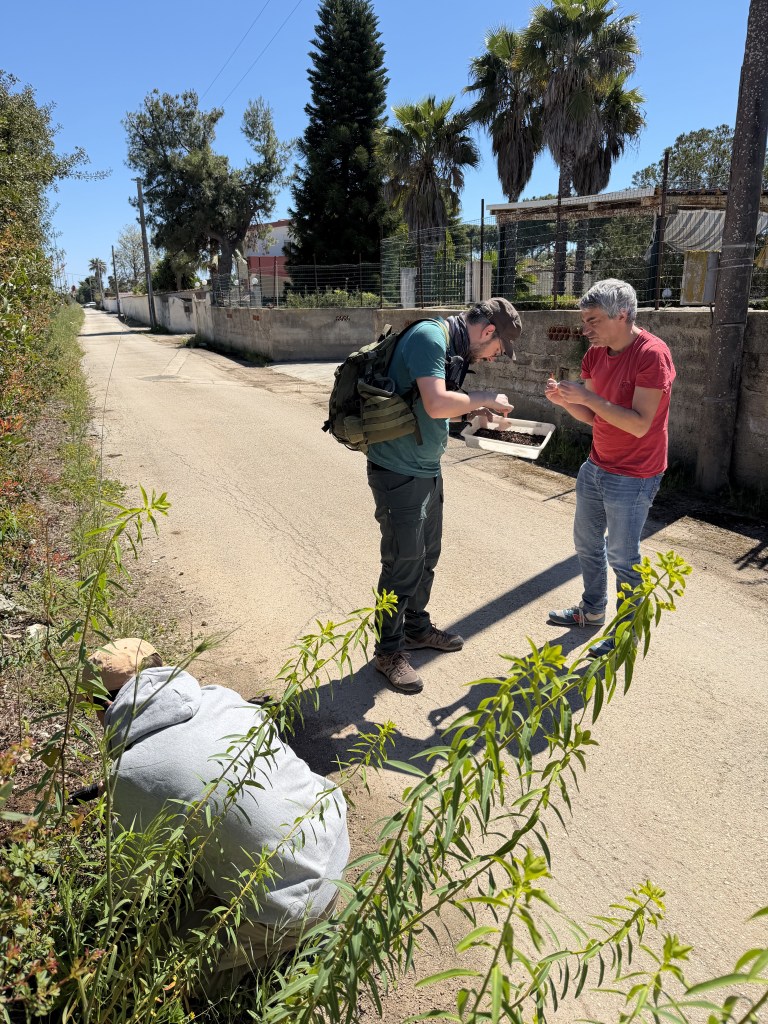
Enrico’s colleagues and coauthors collecting from a fire ant colony near Siracusa, Sicily, in April 2026; from left to right: Hugo Deshayes, Mattia Menchetti, and Stefano Mona, from Paris and Berlin.
Key methodologies. In this paper we combined our new discoveries of invaded Solenopsis invicta sites, interviews with locals in invaded areas regarding the date of arrival of the invasive ants, and decades of data collected on other ant species in the area as well as community science records from iNaturalist.org. Overall, the methodological approach was simple, but interviewing residents proved a surprisingly interesting way to reconstruct a possible timeline of an invasion that had gone unnoticed for such a long time. Above all, the paper provides a huge amount of ‘basic’ fieldwork-based data that is critical to understand the scale of the S. invicta invasion and its potential impacts.
Unexpected challenges. The most unexpected results were some worrying first records of fire ants from relatively natural areas, and the timescale of the invasion recalled by locals, placing its start potentially in the 1990s in multiple areas (decades before the first detection and the EU legislation on Invasive Alien Species). Our role has been that of discovering the fire ants’ presence in Italy, then reporting on their wide distribution, initially to the relevant authorities, and then to the scientific community and general public through our papers, all as independent researchers. We had limited time, resources, and access mostly only to public areas. We often encountered local residents desperate for somebody to intervene, having the surroundings of their houses full of stinging ants, but that is obviously beyond our possibilities and role: The regional authorities are in charge of the complex monitoring and eradication/management efforts that the EU legislation mandates.
Major results. Our results depict a dramatic increase in the invaded range of S. invicta, with records about 60 km west and 120 km north from what was previously known, increasing the area of occupancy from 36 km² to 88 km² into two new Sicilian provinces. At many sites, locals recall the presence of fire ants already from 18 to 36 years ago. Other ants in these areas are probably the first organisms affected by the fire ants and should also be taken into account in eradication/management measures. We listed 78 other species through over 1,850 new records (only 151 for 41 species were previously available). These include endemic species and vulnerable species according to the IUCN Red List, but also other non-native species. The lack of biosurveillance and of ant studies in the region is what allowed the S. invicta invasion to go undetected, as well as the presence of other non-native species and of vulnerable and endemic native ants. There is currently an infringement procedure against Italy by the EU for failing to prevent and manage the invasion in a timely manner; based on the situation in the field we are not at all optimistic about the containment of the invasion and presently find complete eradication hard to imagine.
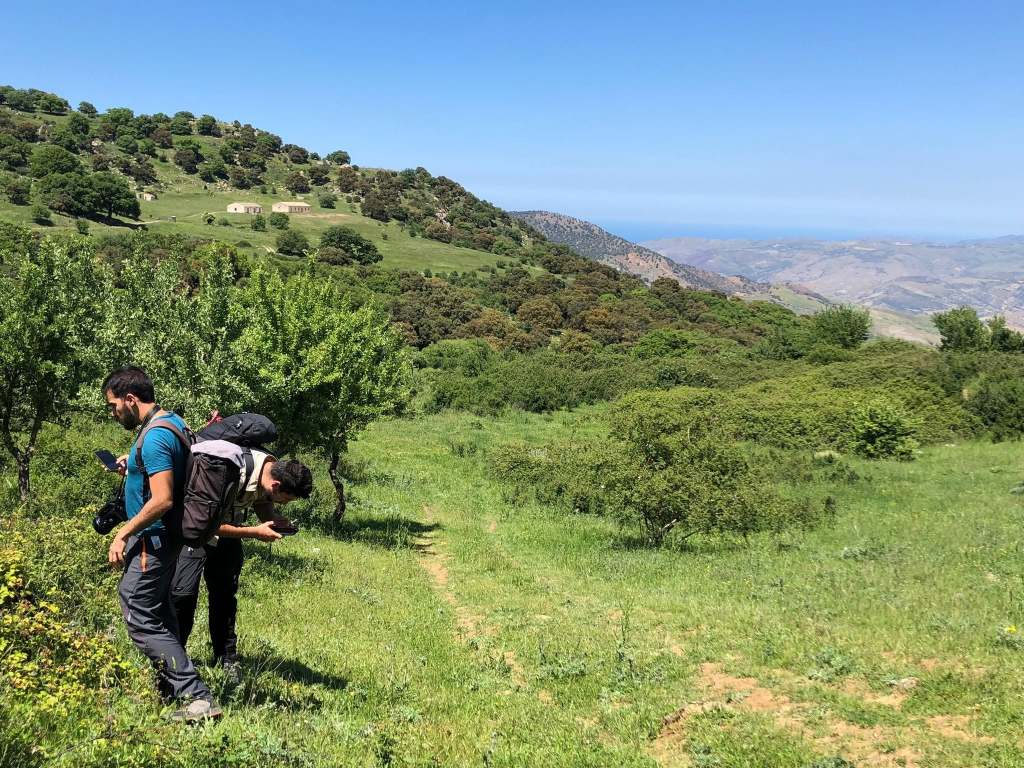
A fieldwork session in a natural area of western Sicily, still a haven far from the fire ant invasion, alongside Enrico’s friend and biologist Marco Pecoraro (left).
Next steps for this research. The most important first action for dealing effectively with the fire ant invasion is to track down its distribution, which is not an easy task for a species with great dispersal capabilities that can remain undetected for a long time, and it requires a sustained and extensive effort by the competent authorities. Our experience in this regard suggests that the active engagement of locals with a community science approach, in which residents signal the possible presence of fire ants in their areas and myrmecologists verify the identity of the records, is by far the single most cost-effective and useful measure. If the population of S. invicta in eastern Sicily was discovered after such a long delay, undiscovered ones could exist elsewhere in Sicily, Italy or even Europe.
If you could study any organism on Earth, what would it be? I plan to stick with ants for the foreseeable future, as I see them as an inexhaustible source of curiosity and marvel, but I also enjoy studying other animals when the occasion arises. I have published on stag beetles, flies, dragonflies, jellyfish, land planarians, spiders, solifuges and snakes. In the future, I would like to have the chance to work a bit more on dragonflies and freshwater insects, and perhaps also on termites. But yes, myrmecology is likely to always remain my main focus.
Is there anything else you would like to tell us about yourself or your featured research? Basic faunistic research, and even taxonomic revisions, which are both very dear to me, are often somewhat discouraged by the current system of research evaluation at least in many countries. However, their importance should not be underestimated, as these kinds of studies are foundational and necessary to all the ‘next steps’, including approaching wider biogeographical questions. When it comes to non-native and invasive ant species, faunistic studies and community science projects can greatly contribute to tracking invasion processes. At the same time, the discovery of more and more new non-native ant species in Europe every year, mostly by amateur entomologists, raises fundamental questions about the biosecurity and biosurveillance mechanisms in place. Currently, I am also working on an update on the Asian needle ant Brachyponera chinensis, which is being detected in more countries on the continent.

