Bailey recently started as a teaching professor at Merced college. He is a marine biologist with a special focus on insular aquatic habitats. Here, Bailey shares his recent work on the fish communities of the Palau marine lakes.
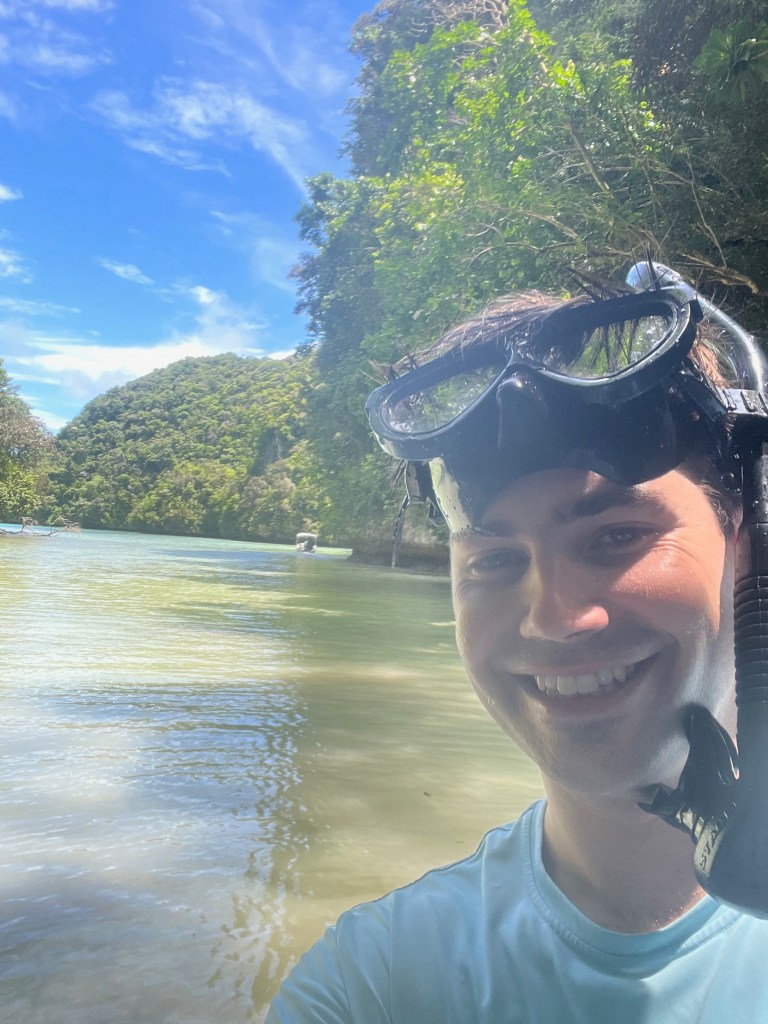
Bailey, after a good day of sampling in the beautiful waters of Palau!
Institute. Merced College, Merced, United States of America
Academic life stage. Professor
Major research themes. Island biogeography; marine biology
Recent paper. Carlson BJ, Myers RF, Dawson MN. (2026). Community diversity of marine fishes in complete and habitat islands. Frontiers of Biogeography, 19: e141935. https://doi.org/10.21425/fob.19.141935
Current study system. Fishes inhabiting the Palau marine lakes are my current focus! The marine lake system in Palau is aesthetically captivating and sublime for scientific investigations in ecology and evolution. If you ever get the chance to visit Jellyfish Lake in Palau, I doubt you will be let down by its serenity and beautiful golden jellies to the interactions of organisms and their naivete towards predators and the overall environmental framework isolating it from the ocean. I’m now the third academic generation exploring marine lakes, yet these microcosms of the marine environment and putative analogs of terrestrial islands still remain an enigma. As we discuss in our paper, the marine lakes can bridge the divide between marine biology and island biogeography.
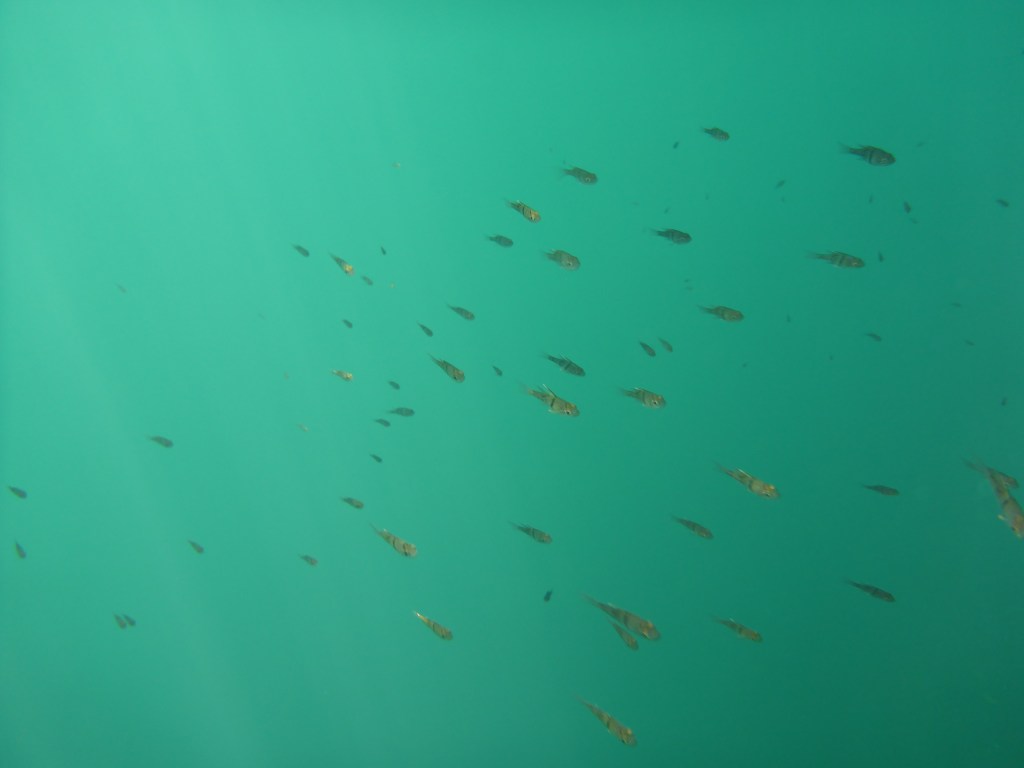
A school of orbiculate cardinalfish, Sphearamia orbicularis, in a marine lake.
Motivation behind this paper. Our motivation was to explore whether communities of fishes inhabiting marine islands showed similar patterns to terrestrial organisms of oceanic islands. An earlier paper, “Islands and island-like marine environments” by my advisor Mike, had discussed the development of marine island biogeography, illustrating its relevance, and the similar environmental isolation of marine lakes when compared to oceanic islands. That idea had grown out of Mike’s and his former advisor Bill Hamner’s (2005) identification of isolated populations and differentiation within the marine lakes and description of five new subspecies of Mastigias jellyfish (Dawson 2005). But nobody had ever looked at patterns of species diversity. So, I was thrilled to participate in exploring patterns of community diversity in marine lakes and whether they were shared with oceanic islands.
Key methodologies. Beyond the novelty of investigating island patterns within marine environments, we also investigated not just species diversity but phylogenetic and functional diversity within each marine lake and among marine lakes that share similar environmental features. Each of these diversity measures is common in ecological research, but we wanted to investigate them collectively to see whether patterns were shared across diversity measures. Using alpha and beta diversity in our methodology also allowed us to see patterns unique to each lake and distinct similarities between marine lakes when incorporating the environmental data that was collected. The data collection for this project was supported by many people within the Dawson Lab at UC Merced and the Coral Reef Research Foundation, without who the work would have been impossible.
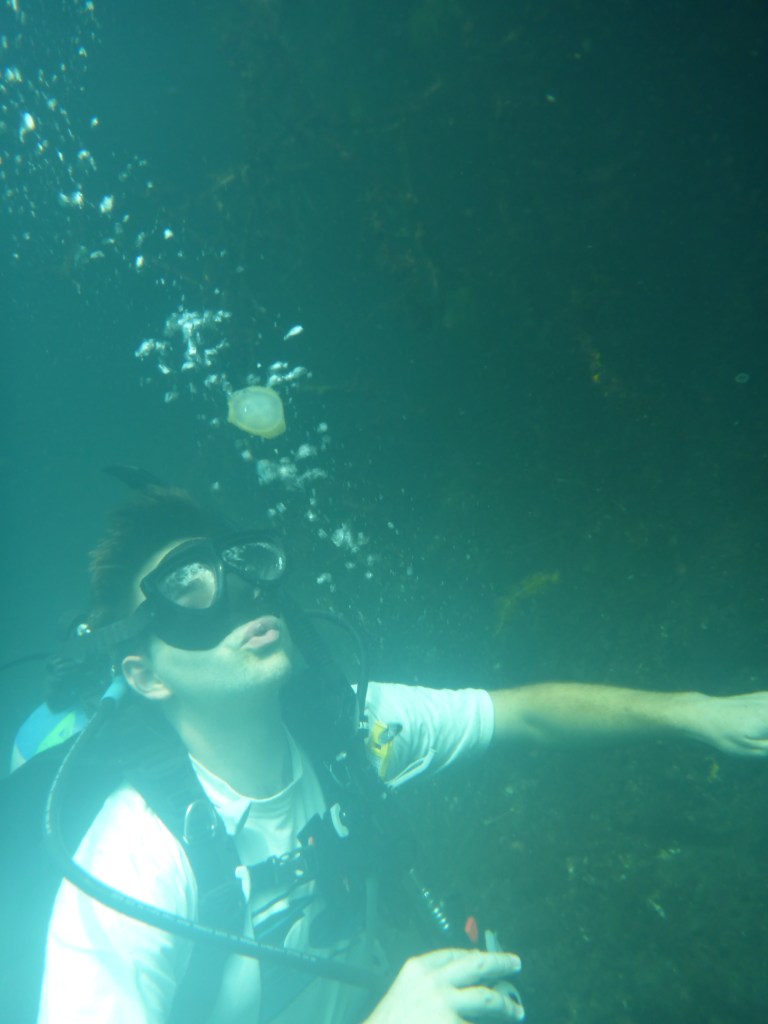
Diving in a marine lake and checking out the incredible golden Mastigias jellyfish.
Unexpected challenges. Lead-authoring your first paper in and of itself is a challenge: Learning to write in the scientific style, becoming familiar with the history of a topic and which are the key references to cite, and mastering statistics and which analyses and packages can perform the methods we want are all hurdles as a graduate student. In exploring the questions we set out for this project, there were many options in R, which eventually we worked through, and we have the editors and anonymous reviewers at Frontiers of Biogeography to thank for their generous feedback and support through out the review process! One challenge I did not have was collecting the data — my co-authors had done that several years ago — but that came with its own difficulties: Lack of first-hand experience with the collections, datasets, and ecosystems. Getting intimately familiar with those things remotely requires trying to imagine remote and rare places, which didn’t become real until I was able to visit several years later.
An unexpected outcome from our results was how the category of marine lakes most similar in their species, phylogenetic, and functional alpha and beta diversity patterns to oceanic islands had a species-area relationship slope of nearly 0, while the other category of marine lakes most similar in their patterns to habitat islands had a species-area relationship slope value of 0.35. Based on Rosenzweig’s Species-Area Curve, the marine lakes most similar to habitat islands had a species-area slope value very similar to what is expected of islands (0.25–0.45). We think this is because the marine lakes represent very early disequilibrium stages of the formation of ‘islands’, providing unusual insight into general processes. The exciting proposition here is that, given we only sampled 16 of the ~57 marine lakes in Palau (and 200+ globally), future research can investigate this further to understand if the pattern holds with a larger sample size and if so, what are the mechanisms behind this intriguing finding.
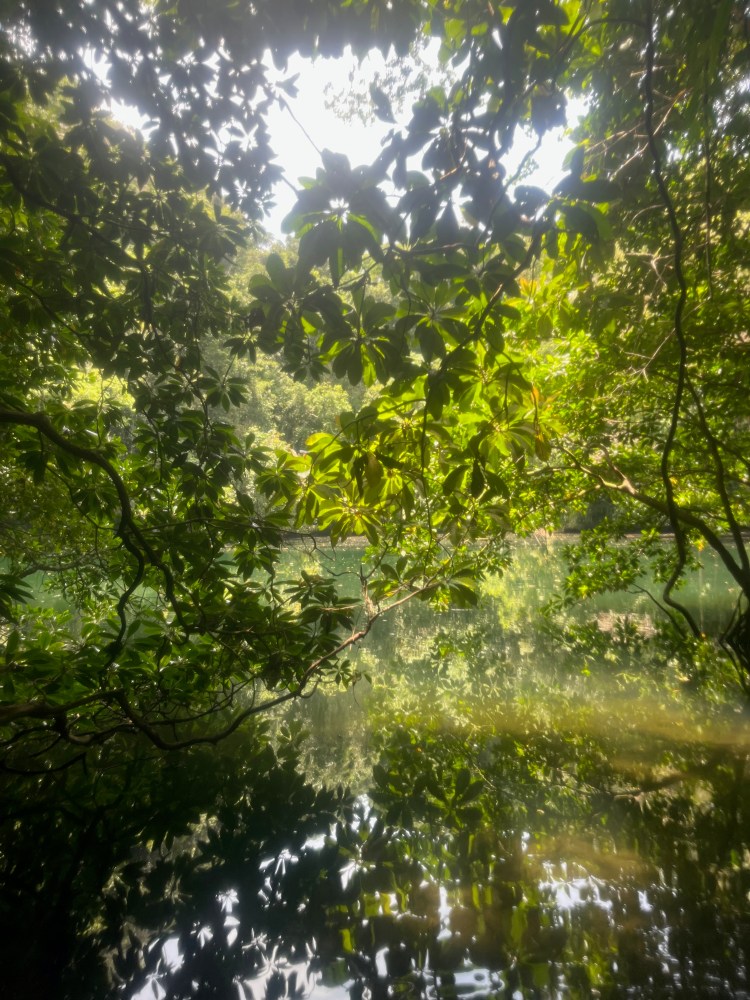
A placid Palauan marine lake reflecting the overhang limbs and leaves.
Major results. The main result from this paper is that marine lakes are islands. Also, that, rather than some marine lakes being islands and others not, a more appropriate perspective when investigating marine lakes is to consider a gradation or continuum of development. Some marine lakes showed similar patterns to the ocean habitats while others had similar patterns to oceanic islands, and there was a mix in between. We also observed, as others have identified in island biogeography, that taking a biophysical perspective of islands is a wise approach since for some organisms, an island is isolation, while for others, an island is a stepping stone to the next destination.
Next steps for this research. The next step is to move from fish communities to fish populations. Do we see population patterns that parallel the ecology of fish communities in marine lakes? This work will build on prior descriptions of the evolution of jellyfish in the marine lakes. How do patterns of fish populations compare to the previously described evolution of jellyfish in marine lakes? Furthermore, is the evolution of fish populations in marine lakes similar to what has been observed for terrestrial species on oceanic islands?
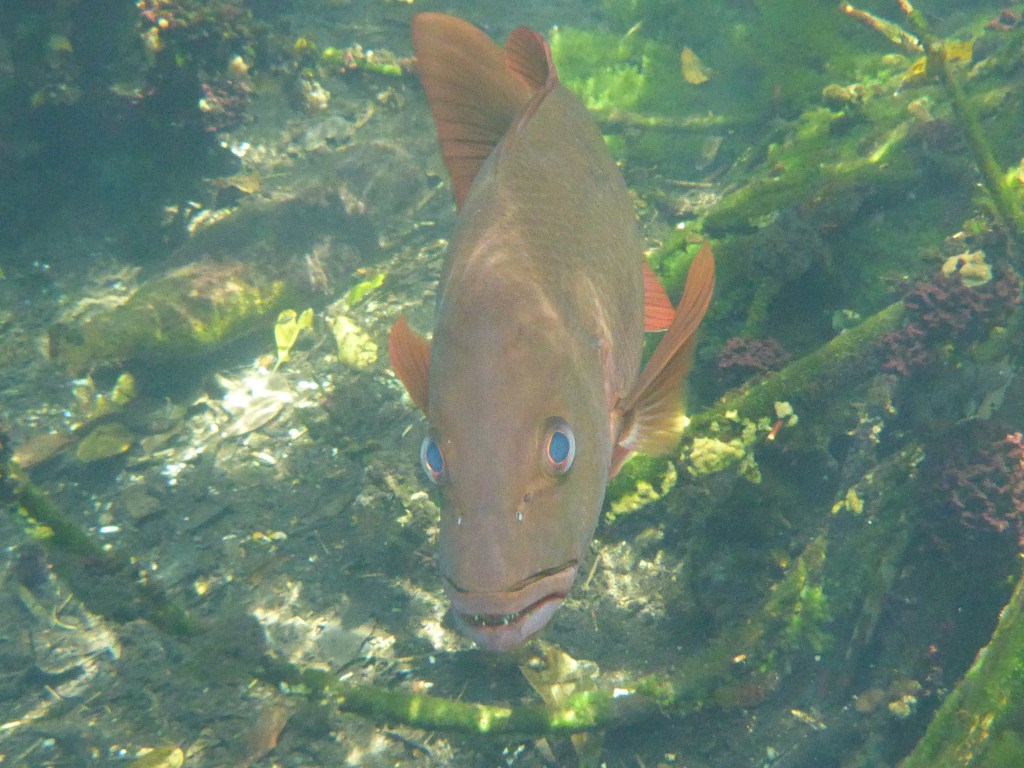
An overly friendly mangrove red snapper, Lutjanus argentimaculatus, in a marine lake.
If you could study any organism on Earth, what would it be? Oh, that’s not a fair question haha! I have participated in research working with invertebrates, conducted research working with fish, and now I teach classes focused on human biology and it’s all so fascinating. However, if you asked me if I could only study one system on Earth, then I can easily say marine lakes. The memories I have of conducting fieldwork in the marine lakes are ones that I will never forget. I can remember swimming through the cold brackish layer only to find the warm salty layer underneath, but the contrast was unlike anything I had experienced in the ocean. The fish surrounding you like an audience because they were curious what you were doing. Imagine tens of cardinalfish encompassing you from all sides while you snorkel and work, those are the special moments! The endless questions running through my head while being in and around the marine lakes. The marine lakes are incredible environments worth conserving and I am grateful to have had the opportunities I did working in them.
Is there anything else you would like to tell us about yourself or your featured research? Always keep an eye out for crocodiles! During a trip to one of the marine lakes in Palau, I was swimming back and forth along a length of shoreline and unbeknownst to me, I kept passing a crocodile hidden amidst a tangle of mangrove roots! Thankfully this one was small, but I could have been the oblivious snack to a larger one! When observing an environment as a scientist, large predators are a good thing to keep in mind. Unfortunately for me, the picture quite obviously shows a crocodile but I was completely unaware!
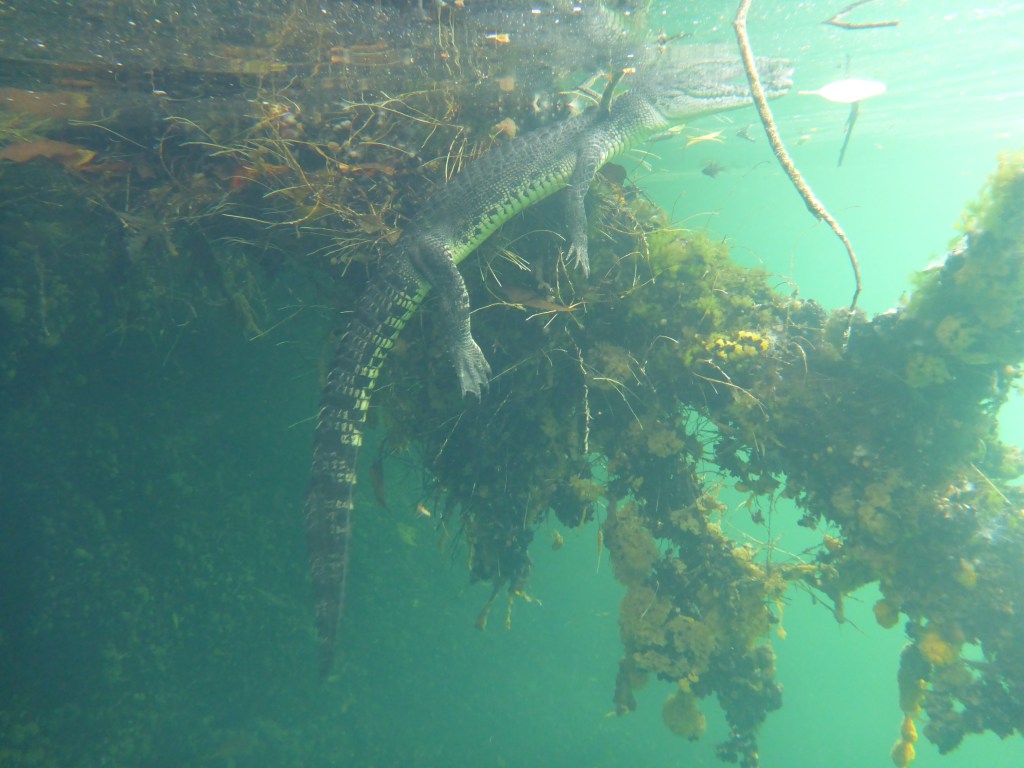
The crocodile Bailey overlooked when swimming in a marine lake

